

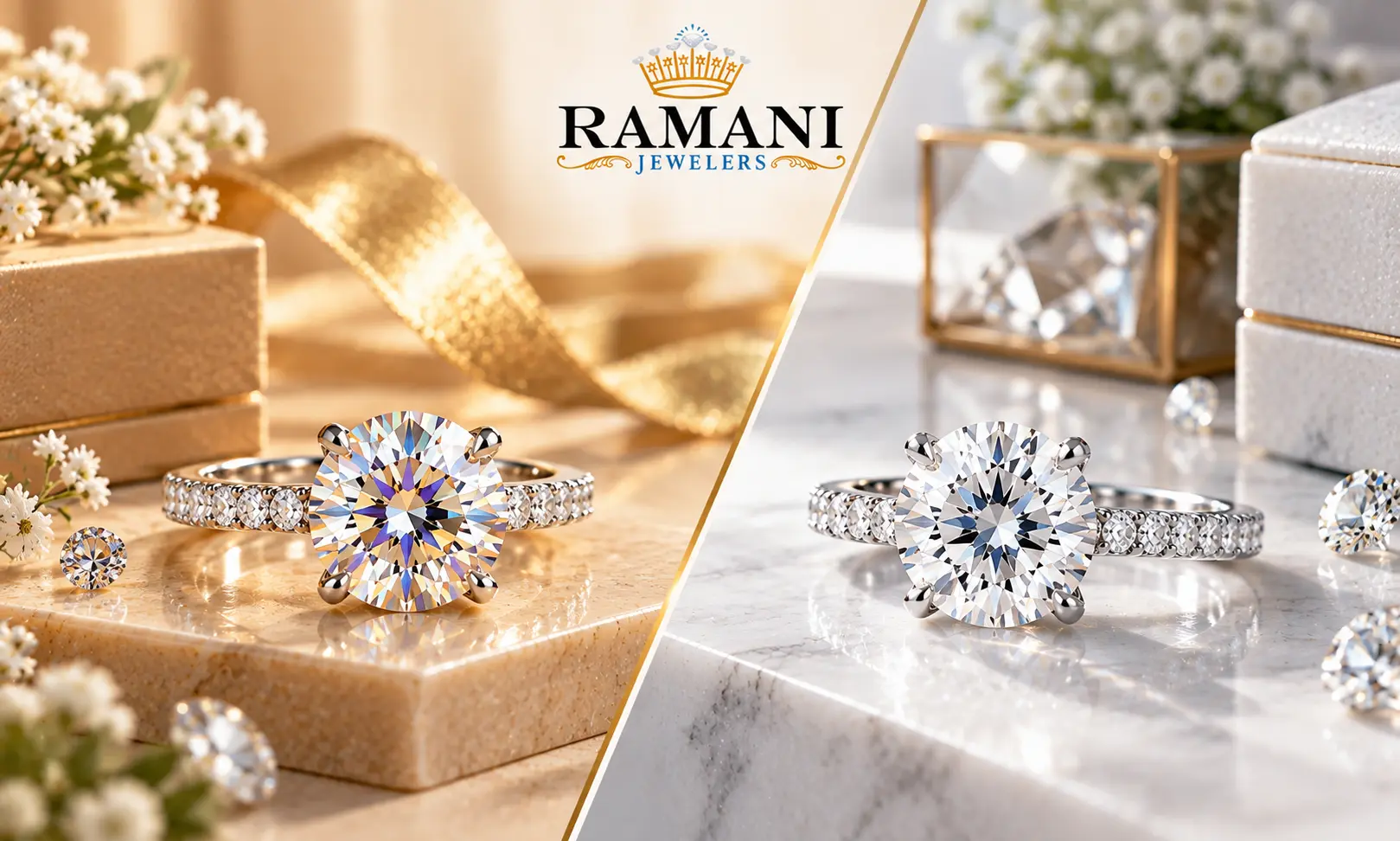
When shopping for an engagement ring, wedding ring, or fine jewelry, you may come across two popular options: moissanite and lab-grown diamonds. Both can offer impressive brilliance, durability, and beauty, but they are not the same gemstone.
One of the biggest differences is simple: a lab-grown diamond is a diamond, while moissanite is a different gemstone that resembles a diamond. Moissanite is made from silicon carbide, while diamonds are made from carbon.
Understanding the differences between these stones can help you choose a piece of jewelry that matches your style, budget, and expectations.
At Ramani Jewelers, we help customers explore a wide range of fine jewelry and diamond options. If you’re considering a diamond purchase, you can also explore our diamond collection to see available styles.
What Is Moissanite?
Moissanite is a gemstone made from silicon carbide. Natural moissanite is extremely rare, so the moissanite used in modern jewelry is generally laboratory-created.
Its popularity comes from its impressive brilliance, durability, and diamond-like appearance. To the untrained eye, a well-cut moissanite can look remarkably similar to a diamond.
However, moissanite has its own optical characteristics. It can produce more noticeable flashes of colorful “fire” than a traditional diamond, creating a distinctive rainbow-like sparkle.
Moissanite can therefore be an attractive option for shoppers who want a brilliant gemstone with a diamond-inspired appearance while working within a particular budget.
What Is a Lab-Grown Diamond?
A lab-grown diamond is a real diamond created in a controlled laboratory environment rather than formed naturally underground.
According to the Gemological Institute of America (GIA), laboratory-grown diamonds have the same crystal structure and nearly the same chemical, optical, and physical properties as natural diamonds. They are produced using technologies such as Chemical Vapor Deposition (CVD) and High-Pressure High-Temperature (HPHT).
The primary distinction is their origin.
A mined diamond forms naturally over extremely long geological periods, while a lab-grown diamond is produced in a laboratory under controlled conditions.
This makes lab-grown diamonds an option for shoppers who specifically want a diamond while looking for an alternative to a mined stone.
Moissanite vs. Lab-Grown Diamonds: Key Differences
| Feature | Moissanite | Lab-Grown Diamond |
|---|---|---|
| Material | Silicon carbide | Carbon |
| Is it a diamond? | No | Yes |
| Origin | Usually laboratory-created | Laboratory-created |
| Hardness | About 9.25 on Mohs scale | 10 on Mohs scale |
| Appearance | Diamond-like with colorful fire | Traditional diamond brilliance |
| Sparkle | Strong brilliance and rainbow fire | Bright white brilliance with fire |
| Durability | Excellent | Excellent |
| Certification | Depends on seller/stone | Grading reports are commonly available |
| Price | Generally lower | Generally higher than moissanite |
| Best known for | Value and distinctive sparkle | Authentic diamond characteristics |
The most important distinction is the material itself. Moissanite and lab-grown diamonds may look similar, but they have different chemical compositions and physical characteristics.
1. Appearance and Sparkle
Sparkle is one of the first things most people consider when comparing these stones.
Moissanite is known for its intense brilliance and colorful flashes. Its optical properties can produce noticeable rainbow fire, particularly under certain lighting conditions.
Lab-grown diamonds provide the classic appearance associated with diamonds. Their brilliance, fire, and scintillation depend on factors such as cut, clarity, color, and proportions.
If you prefer a more traditional diamond appearance, a lab-grown diamond may better match your expectations. If you enjoy pronounced colorful flashes and a distinctive sparkle, moissanite may appeal to you.
Neither appearance is inherently “better.” The choice comes down to the visual effect you prefer.
2. Durability
Durability is particularly important for engagement rings and other jewelry worn every day.
Diamond is the hardest naturally occurring mineral and ranks 10 on the Mohs hardness scale. Lab-grown diamonds have the same crystal structure and hardness characteristics as natural diamonds.
Moissanite is also highly durable, with a hardness of approximately 9.25 on the Mohs scale.
Both are suitable for everyday jewelry, but a diamond has the higher hardness rating.
Regardless of the gemstone you select, proper jewelry care remains important. Regular cleaning and professional inspections can help keep your ring looking beautiful.
3. Price
Price is another major difference between moissanite and lab-grown diamonds.
Moissanite is generally less expensive than a comparable lab-grown diamond. This can allow shoppers to select a larger gemstone or allocate more of their budget toward the ring setting, metal, or other jewelry details.
Lab-grown diamonds can also offer significant savings compared with natural diamonds, while still being genuine diamonds.
However, there is no single price difference that applies to every stone. Factors such as carat weight, cut, color, clarity, shape, certification, and retailer pricing can all affect the final cost.
Instead of comparing gemstones based only on carat size, consider the complete specifications of each stone.
4. Certification and Grading
Certification and grading are important when purchasing a significant gemstone.
Laboratory-grown diamonds can be evaluated by professional gemological laboratories. GIA, for example, provides laboratory-grown diamond reports that include information about color, clarity, and other characteristics. GIA can also identify whether a laboratory-grown diamond was produced using HPHT or CVD technology.
Moissanite is generally not graded in the same way as diamonds because it is a different gemstone.
When shopping for either stone, ask what documentation accompanies the purchase and make sure the product description clearly identifies the gemstone.
5. Diamond Appearance vs. Diamond Identity
This is perhaps the most important question to ask yourself:
Do you want a gemstone that looks like a diamond, or do you specifically want a diamond?
Moissanite can provide a beautiful diamond-like appearance, but it is not chemically a diamond.
A lab-grown diamond, on the other hand, is a diamond. Its laboratory origin does not change the fact that it has a diamond crystal structure.
GIA specifically distinguishes diamond simulants such as moissanite from laboratory-grown diamonds.
Knowing this difference can help prevent confusion when comparing products online or in a jewelry store.
6. Which Is Better for an Engagement Ring?
Both gemstones can work beautifully in an engagement ring.
A moissanite engagement ring may appeal to someone who:
- Wants a highly brilliant gemstone
- Loves colorful flashes of fire
- Wants to maximize gemstone size within a budget
- Is comfortable choosing a diamond alternative
- Prefers the distinctive appearance of moissanite
A lab-grown diamond engagement ring may appeal to someone who:
- Specifically wants a real diamond
- Prefers traditional diamond brilliance
- Wants diamond grading documentation
- Likes the idea of a laboratory-created diamond
- Wants diamond characteristics without purchasing a mined diamond
The right choice ultimately depends on what matters most to you.
7. How Cut Affects Both Stones
Regardless of whether you choose moissanite or a lab-grown diamond, cut quality matters tremendously.
Cut influences how a gemstone interacts with light. A well-cut stone can appear bright, lively, and balanced, while a poorly cut stone may appear less brilliant.
When comparing two stones, don’t look only at carat weight.
Consider:
- Cut quality
- Shape
- Color
- Clarity
- Proportions
- Certification or documentation
- Setting style
- Overall appearance under different lighting
A slightly smaller stone with excellent proportions can sometimes create a more attractive visual impression than a larger stone with weaker cutting.
8. Popular Shapes for Engagement Rings
Both moissanite and lab-grown diamonds can be found in many popular shapes.
Some common choices include:
- Round
- Oval
- Cushion
- Emerald
- Princess
- Pear
- Marquise
Round cuts are especially popular for their classic appearance, while oval and pear shapes can create the visual impression of a larger stone.
Your ring setting also affects the final appearance. Halo, solitaire, three-stone, and bezel-style settings can each create a very different look.
If you’re exploring diamond jewelry, take a look at the diamond jewelry collection at Ramani Jewelers for inspiration.
Moissanite vs. Lab-Grown Diamond: Which Should You Choose?
There is no universal answer.
If your priority is getting a diamond, a lab-grown diamond is the straightforward choice because it is a genuine diamond created in a laboratory.
If your priority is diamond-like beauty, strong durability, and a lower gemstone cost, moissanite may be worth considering.
Think about these five questions before making your decision:
- Do I specifically want a diamond?
If yes, consider a lab-grown diamond. - Do I enjoy colorful sparkle?
If yes, moissanite may be appealing. - What is my overall jewelry budget?
Consider the gemstone together with the setting and other design details. - How important is certification to me?
Ask what documentation is available for the gemstone you’re considering. - Which stone looks better to my eyes?
Whenever possible, compare stones in person and under different lighting conditions.
Final Thoughts
Moissanite and lab-grown diamonds are both popular choices for modern jewelry, but they serve different preferences.
Moissanite is a silicon-carbide gemstone known for its brilliance, durability, and colorful fire. Lab-grown diamonds are genuine diamonds with the same basic crystal structure and key physical characteristics as mined diamonds.
The best choice is the one that fits your personal style, expectations, and budget.
Before purchasing, compare the actual stones rather than relying only on photographs or carat weight. Look at the cut, color, clarity, proportions, documentation, and overall appearance.
If you’re ready to explore diamond jewelry, visit Ramani Jewelers or browse the Ramani Jewelers diamond collection to explore available options.
FAQs
Is moissanite a lab-grown diamond?
No. Moissanite and lab-grown diamonds are different materials. Moissanite is silicon carbide, while a lab-grown diamond is crystallized carbon.
Is a lab-grown diamond a real diamond?
Yes. Laboratory-grown diamonds have the same fundamental crystal structure as natural diamonds and can be identified and evaluated by professional gemological laboratories.
Which is harder, moissanite or lab-grown diamond?
Diamond ranks 10 on the Mohs scale, while moissanite is approximately 9.25, making diamond harder.
Does moissanite look like a diamond?
Yes. Moissanite can have a diamond-like appearance, but its optical characteristics can produce more noticeable colorful fire.
Is moissanite cheaper than a lab-grown diamond?
Generally, yes. However, actual prices vary based on size, quality, cut, brand, and other factors.
Can moissanite be used in an engagement ring?
Yes. Its high durability and brilliance make it a popular choice for engagement rings and other everyday jewelry.