

There’s a drawer like this in almost every house. One earring whose match vanished years ago. A chain with a clasp that gave out. A class ring nobody has worn since high school, and a bracelet from an aunt you loved but whose taste you never shared.
Gold has spent most of 2026 near record territory, with some sharp swings along the way, so plenty of people are wondering whether now is the moment to sell gold jewelry they never wear. Deciding to sell is the easy part. Knowing whether the offer in front of you is fair is the hard part, because most people do this once or twice in a lifetime, while the person across the counter does it fifty times a day.
Here are the ten questions worth asking before anything changes hands. Some are for the buyer. A few are for you.
1. Do I actually want to sell this, or would a trade-up feel better?
Start here, because melting is permanent. Once a piece goes into the pot, it’s gone, and no amount of regret brings it back.
Ask yourself whether the pieces you’re holding are truly dead weight or just out of step with how you dress now. A heavy 22K necklace you never wear can become a pendant and a pair of studs you’d wear weekly. An inherited ring you don’t love can be reset with the same stone into something that feels like yours.
Many jewelers, including ours, will apply the value of old gold directly toward a new or custom piece. If that appeals to you, look at our gold exchange option before you commit to a straight cash sale.
2. What karat is my gold, and what does it weigh?
These two numbers drive almost everything else. Karat tells you purity; weight tells you quantity. Together they tell you how much actual gold you own.
Check for a stamp inside a ring band, on a clasp, or on the back of a pendant. Here’s what those marks mean:
- 10K is about 41.7% gold
- 14K is about 58.5% gold, the most common in American jewelry
- 18K is 75% gold
- 22K is about 91.6% gold, common in Indian and South Asian jewelry
- 24K is 99.9% gold, usually coins and bars rather than wearable pieces
- A kitchen scale will get you a rough weight in grams. It won’t be exact, and stones and clasps add weight that isn’t gold, but walking in with a ballpark number changes the conversation. You stop being a guest and start being a seller who knows what’s in the bag.
3. Is this piece worth more as jewelry than as gold?
This is the question that saves people the most money, and almost nobody asks it.
Scrap value is simple math: purity times weight times the market. But some pieces are worth well beyond their melt value. Signed designer work, antique and estate pieces, high-quality diamonds, colored gemstones, and luxury watches often sell for far more intact than melted.
Picture two rings on the same counter. One is a plain 14K band, and its value is pure arithmetic. The other is a 1930s filigree ring with a good old-cut diamond, and melting it would destroy most of what makes it valuable. An honest buyer will tell you which one you’re holding, even when the answer costs them money on the deal.
4. What is gold actually trading at today?
The gold market moves every day, sometimes dramatically. The price this morning isn’t necessarily the price this afternoon, and it’s certainly not the price from the article you read last spring.
Spend two minutes checking the current spot price before you walk into any store. You don’t need to track the market like a trader. You just need enough context to recognize an offer that doesn’t line up with reality.
Quick math if you want it: spot price divided by 31.1 gives you the price per gram of pure gold. Multiply that by your karat purity, then by your weight in grams. That’s your raw gold value before any dealer margin.
5. What percentage of that value am I being offered?
Every buyer keeps a margin. That’s not a scandal, it’s a business. The question is how big that margin is, and whether they’ll tell you without flinching.
Ask directly: what percentage of the market value is this offer? Then ask them to show the calculation. Weight, karat, current rate, payout percentage, final number. A buyer who walks you through the arithmetic is a buyer you can check. A buyer who just names a price and waits is a buyer who’s counting on you not knowing the difference.
Payout rates vary widely between storefronts, which is why comparing two or three offers is almost always worth the drive. Our own rates and process are laid out on our we buy gold page, along with the day’s market price.
6. Will you test and weigh it in front of me?
If your gold disappears into a back room, that’s your cue to collect it and leave.
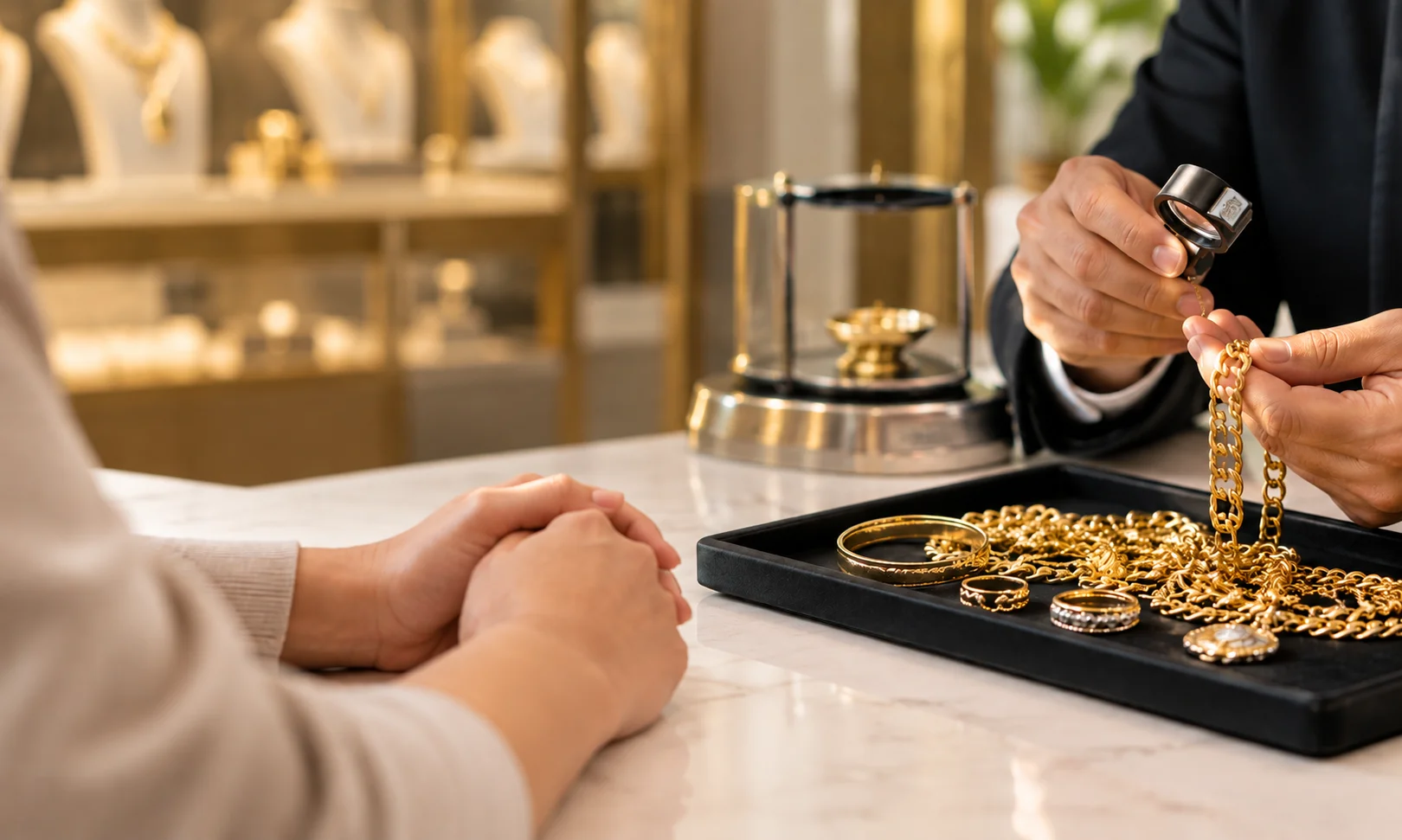
Testing and weighing should happen on the counter, in your line of sight, on a certified scale. You should be able to watch the acid test or the electronic tester do its work and see the reading yourself. Nothing about this process needs privacy.
At our store, every appraisal happens in front of the customer, and our certified gemologists explain what they’re doing as they go. It takes a few extra minutes. It also means nobody leaves wondering what happened out of sight.
7. What happens to my diamonds and gemstones?
Gold buyers buy gold. That doesn’t automatically mean they’re buying the stones set into it, and it definitely doesn’t mean those stones are included for free.
Before the sale, ask plainly: are the stones being removed and returned to me, valued separately, or included in this offer? All three are legitimate answers. Silence is not.
This matters most with older bridal jewelry. A dated setting may be worth little, while the center diamond in it is worth a great deal, and those two facts belong in separate columns.
8. Is this buyer licensed, bonded, and still going to be here next year?
Gold rallies attract temporary operators. Hotel ballroom buying events, pop-up shops, and vans parked outside a strip mall all appear when prices climb, and all of them are gone by the time you have a question.
Look for a licensed, bonded buyer with a real storefront, a street address, and a history in the area. Read the reviews, and pay attention to what repeat customers say rather than the star count alone.
Our family has been at the same Preston Road address since 1987. You can read more about the store and the people behind it on our about page.
9. How and when do I get paid?
An offer isn’t money. Payment terms are part of the deal, so settle them before you agree to anything.
Ask what form of payment you’ll receive, and when. Cash, check, or bank transfer on the spot are all reasonable. A promise to mail something in ten business days is not, at least not without a written receipt describing every item, its weight, and the agreed price.
If you’re mailing gold in from outside Dallas, the standard applies just as firmly: insured and tracked shipping, a written offer after appraisal, and your absolute right to say no and have everything shipped back.
10. Do I need an appraisal or paperwork before I sell?
Sometimes yes. Inherited jewelry moving through an estate, pieces listed on an insurance policy, or anything involved in a divorce settlement usually needs a documented, itemized appraisal before it goes anywhere.
An appraisal is a different service from a buy offer, and it’s worth keeping those two roles separate in your head. We provide independent written appraisals that insurance carriers accept, and you’re free to take that document and sell wherever you like.
One more piece of housekeeping: selling gold can carry tax implications depending on what you paid, what you received, and how long you held it. A tax professional can sort that out in a single conversation, and it’s a good conversation to have before a large sale rather than after.
Where to Sell Gold Jewelry in Dallas, TX
If you’re looking for gold buyers near you in North Dallas, here’s what the process looks like at our showroom on Preston Road.
You bring your items in, or fill out the quote form on our site for a preliminary estimate. Our certified gemologists, Swapnil and Mitesh Ramani, test and weigh everything on certified scales while you watch. You get the calculation and the offer, and if you like the number, you’re paid on the spot by cash, check, or bank transfer. If you don’t like it, you take your gold home with no pressure and no fee.
We buy:
- Gold jewelry from 10K to 24K, in any condition
- Broken chains, single earrings, bent rings, and scrap gold
- Gold coins and bullion
- Sterling silver jewelry and flatware
- Dental gold
- Luxury watches, including Rolex
Not in Dallas? We also buy gold from customers across the country through a secure, insured shipping process. And if you’d rather put the value toward something new instead of taking cash, our bullion and fine jewelry collections are both fair game for a trade.
FAQs
How much is my gold jewelry worth?
It depends on three things: the karat purity, the weight in grams, and the day’s gold market price. A 14K piece is roughly 58.5% gold, so a 20-gram chain contains about 11.7 grams of pure gold. Multiply that by the current per-gram rate and you have your raw value, before any buyer’s margin. Stones, brand, and age can push the number higher.
Do I need an appointment to sell gold in Dallas?
No. You’re welcome to walk in with your items during business hours, and most appraisals take only a few minutes. If you’d rather know roughly where you stand first, fill out the quote form on our website or call ahead at (972) 807-2880.
Will you buy broken or damaged gold jewelry?
Yes. Broken chains, tangled knots, single earrings, and crushed rings are all worth exactly what their gold content is worth. Condition doesn’t change purity, so don’t throw anything out because it looks beyond repair.
Can I sell gold coins and bullion, not just jewelry?
Yes. We buy gold coins, bars, and rounds, along with silver and platinum. Bullion typically pays closer to spot than scrap jewelry does, because there’s no refining work between the metal and its next owner.
Do I need ID to sell gold in Texas?
Yes. Bring a valid government-issued photo ID. Licensed precious metal dealers in Texas are required to record seller identification, which is one of the ways the system protects both you and the store.